Uncategorized
Serverless AI Application Development: A Developer’s Guide to Scalable AI
Learn to build highly scalable, cost-effective AI applications using serverless computing. This developer’s guide covers design, tools, and best practices for serverless AI.


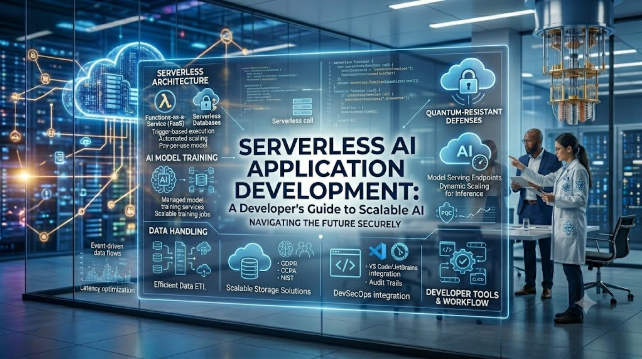
Serverless AI Application Development: A Developer’s Guide to Scalable AI
Building artificial intelligence applications often presents unique scaling challenges. AI models can demand significant computational resources, especially during inference for high-traffic applications or when processing large batches of data. Managing the underlying infrastructure to meet these fluctuating demands can be complex, time-consuming, and expensive. This is where serverless computing emerges as a powerful paradigm, offering a compelling solution for developing highly scalable, cost-efficient, and maintainer-friendly AI-powered applications.
This guide delves into how developers can leverage serverless architectures to streamline the creation and deployment of AI solutions, transforming how we approach machine learning operations in the cloud.
The Synergy: Why Serverless for AI?
Serverless computing abstracts away the operational complexities of servers, allowing developers to focus solely on their code. When applied to AI, this abstraction yields significant advantages, aligning perfectly with the dynamic nature of many AI workloads.
Automatic Scalability
One of the most appealing aspects of serverless is its inherent ability to scale automatically. AI applications often experience unpredictable traffic patterns; an image recognition service might receive bursts of requests, or a natural language processing (NLP) model might be invoked frequently during peak hours. Serverless functions, like AWS Lambda, Google Cloud Functions, or Azure Functions, automatically provision and de-provision resources based on demand. This means your AI application can handle sudden spikes in usage without manual intervention, ensuring consistent performance and user experience.
Cost Efficiency
Traditional server-based deployments often involve provisioning resources for peak demand, leading to idle capacity and wasted expenditure during off-peak times. Serverless computing operates on a pay-per-execution model. You only pay for the compute time and resources consumed when your AI function is actively running. For many AI inference workloads, which can be sporadic, this results in significant cost savings, as you’re not paying for idle servers.
Reduced Operational Overhead
Managing servers, operating systems, and runtime environments diverts valuable developer time away from core AI development. Serverless platforms handle all this infrastructure management, patching, and scaling. This allows AI engineers and data scientists to dedicate more time to model development, experimentation, and feature engineering, accelerating the pace of innovation.
Faster Iteration and Deployment
With less infrastructure to manage, development cycles can be drastically shortened. Serverless functions are typically small, single-purpose pieces of code, making them easier to test, deploy, and integrate into continuous integration/continuous deployment (CI/CD) pipelines. This agility is crucial for AI projects that often require frequent model updates and rapid deployment of new features.
Core Serverless Components for AI
Building a robust serverless AI application involves combining several cloud services. Understanding these foundational components is key.
Function-as-a-Service (FaaS)
FaaS is the cornerstone of serverless architectures. These functions are where your AI inference code will reside. When an event (like an API call, a new file upload, or a database trigger) occurs, the FaaS function executes your AI model to perform a prediction or process data. They are ideal for lightweight, stateless AI tasks.
Serverless Databases
AI applications often require persistent storage for model metadata, user preferences, training data references, or inference results. Serverless databases like AWS DynamoDB, Google Cloud Firestore, or Azure Cosmos DB provide highly scalable, fully managed NoSQL solutions that can handle varying data loads without provisioning servers.
Event-Driven Architectures
The strength of serverless AI lies in its event-driven nature. Message queues (e.g., AWS SQS, Google Cloud Pub/Sub, Azure Service Bus) and event buses (e.g., AWS EventBridge, Google Cloud Eventarc, Azure Event Grid) enable decoupling components and orchestrating complex AI workflows. For example, uploading an image to object storage can trigger a serverless function to perform image analysis.
Object Storage
Cloud object storage services such as AWS S3, Google Cloud Storage, or Azure Blob Storage are essential for storing large AI models, datasets, logs, and intermediate processing results. Their high availability, durability, and cost-effectiveness make them perfect for the heavy data requirements of AI.
Designing Your Serverless AI Application
Architecting a serverless AI application requires careful consideration of how your models, data, and logic interact within the event-driven ecosystem.
Model Deployment Strategy
- Small Models in FaaS: For compact models (e.g., a few hundred MBs), you can embed them directly within your FaaS function’s deployment package or use layers/packages to include dependencies.
- Larger Models from Object Storage: For bigger models, store them in object storage. Your FaaS function can load the model into memory at runtime, often leveraging caching mechanisms for subsequent invocations.
- Specialized Serverless ML Services: For highly demanding or managed inference, consider services like AWS SageMaker Serverless Inference or Google Cloud Vertex AI Endpoints. These services optimize for ML workloads and integrate seamlessly with other serverless components.
Data Ingestion and Preprocessing
Serverless functions can act as powerful data pipelines. An incoming data stream (e.g., IoT sensor data, user input) can trigger a function to clean, transform, and validate the data before it’s stored or fed into an AI model. This ensures data quality and prepares it for efficient processing.
Training Workflows
While serverless functions are generally not ideal for heavy, long-running model training due to execution duration limits, they can effectively orchestrate training jobs. A serverless function can trigger a managed machine learning service (like SageMaker Training Jobs or Vertex AI Training) or initiate a containerized training process on an ephemeral compute instance, then process the results.
Real-time Inference
One of the most common and impactful serverless AI use cases is real-time inference. An API Gateway endpoint can invoke a serverless function containing an AI model. This function processes the input (e.g., text for sentiment analysis, an image for object detection) and returns a prediction almost instantly, making it ideal for interactive applications like chatbots, recommendation engines, or fraud detection systems.
Batch Processing
For large datasets that don’t require immediate processing, serverless can handle batch inference. Data uploaded to object storage can trigger a function that processes chunks of data, applies the AI model, and stores the results back in object storage or a database. This is efficient for tasks like nightly reports or large-scale document analysis.
Best Practices for Serverless AI Development
To maximize the benefits of serverless for your AI applications, consider these best practices:
Optimize Cold Starts
When a serverless function is invoked for the first time or after a period of inactivity, it experiences a “cold start” as the runtime environment needs to be initialized. For AI functions, this includes loading the model. Minimize cold starts by:
- Keeping your deployment package size small.
- Using provisioned concurrency for critical, latency-sensitive functions.
- Optimizing model loading by storing models efficiently.
Resource Allocation
Properly configuring memory and CPU for your FaaS functions is crucial. AI models can be memory-intensive. Experiment with different memory allocations to find the sweet spot that offers good performance without overpaying for unused resources. Higher memory often correlates with increased CPU, leading to faster execution.
Monitoring and Logging
Implement robust monitoring and logging. Cloud services like AWS CloudWatch, Google Cloud Logging/Monitoring (Stackdriver), and Azure Monitor provide insights into function invocations, errors, and resource usage. This is vital for debugging AI models and understanding application performance.
Security Considerations
Apply the principle of least privilege. Grant your serverless functions only the permissions they need to interact with other services (e.g., read from S3, write to DynamoDB). Use VPCs for sensitive data processing and secure your API endpoints with appropriate authentication and authorization mechanisms.
Cost Management
Regularly review your serverless usage and costs. Leverage cloud provider tools to set budgets and alerts. Optimize your code to reduce execution time, which directly impacts cost. Consider data transfer costs, especially when dealing with large datasets between regions.
Common Use Cases for Serverless AI
The versatility of serverless computing opens doors for various AI applications:
- Image and Video Analysis: Object detection, facial recognition, content moderation, and metadata extraction from visual media.
- Natural Language Processing (NLP): Sentiment analysis, text classification, summarization, and building intelligent chatbots.
- Recommendation Engines: Personalizing user experiences by suggesting products, content, or services based on past behavior.
- Fraud Detection: Real-time anomaly detection in financial transactions or user activities.
- Personalization: Tailoring content or experiences dynamically based on user context.
- Automated Data Tagging: Automatically categorizing and tagging unstructured data.
Frequently Asked Questions (FAQ)
Q1: Is serverless suitable for all AI workloads?
Serverless computing is excellent for AI inference and data preprocessing tasks due to its scalability and cost model. However, heavy, long-running model training, especially for large deep learning models, is often better suited for dedicated compute instances, GPUs, or managed machine learning services that can sustain continuous processing for hours or days without interruption limits.
Q2: What are the main challenges of serverless AI development?
Common challenges include managing cold starts (though solutions exist), debugging distributed serverless architectures, potential vendor lock-in, and handling large model dependencies within function package size limits. Careful architectural design and leveraging cloud-specific features can mitigate these.
Q3: How do I handle large AI models in serverless functions?
For models exceeding typical function package sizes, store them in cloud object storage (e.g., S3). The serverless function can then download the model into its ephemeral storage or memory during initialization. Using layers/packages for dependencies and exploring specialized serverless inference services from cloud providers can also help.
Q4: Is serverless cheaper for AI than traditional servers?
Often, yes, particularly for intermittent or spiky AI workloads. The pay-per-execution model means you only pay when your AI model is actively making predictions, eliminating costs associated with idle servers. However, for constant, high-volume workloads, traditional provisioning might sometimes be more cost-effective. It’s crucial to analyze your specific usage patterns.
Conclusion
Serverless computing offers a transformative approach to building and deploying AI applications. By offloading infrastructure management and embracing an event-driven, pay-per-use model, developers can create highly scalable, resilient, and cost-efficient AI solutions. This paradigm shift allows teams to focus their energy on refining models and delivering innovative AI-powered features, rather than grappling with server provisioning and maintenance. As AI continues to evolve, integrating serverless architectures will undoubtedly remain a cornerstone for agile and effective AI application development.
Category: AI & AUTOMATION
Tags: Serverless Computing, AI Development, Machine Learning, Cloud Computing, Scalable Applications, AWS Lambda, Azure Functions, Google Cloud Functions